I have looked at over two hundred CVs in my life – from friends, family, and people at church. Most of them are bad. Not because the person has no skills, but because they don’t know how to present themselves. In this post I will teach you how to write a CV that will make a recruiter call you back. This is not a fancy template from the internet. This is what actually works in South Africa in 2026.
First, let me tell you what a CV is not. It is not a list of everything you have ever done since primary school. It is not a biography. And it is not a document where you beg for a job. A CV is a marketing tool. You are selling yourself to an employer. So you only put information that makes you look good for that specific job.
The length: For most South African jobs, your CV should be two to three pages. Not one page (that is for American jobs). Not five pages (nobody will read that). Two to three pages is perfect.
The sections you need:
- Personal details – your full name, ID number, phone number, email address, and suburb (not your full home address). Do not put your date of birth unless they ask. Also do not put a photo unless it is a customer service job where appearance matters.
- Profile or summary – three or four sentences about who you are. For example: “I am a hardworking admin assistant with two years experience in a law firm. I am good at typing, filing, and customer calls. I want to grow into a office manager role.” Do not write “I am a dynamic go-getter” – that means nothing.
- Work experience – list your jobs from most recent to oldest. For each job write: company name, your job title, dates worked, and three to five bullet points of your duties. Use action words like “managed”, “helped”, “organised”, “trained”, “sold”. If you have no formal job, write “volunteer work” or “self employed” and describe what you did.
- Education – start with your highest qualification. Matric counts. Include the school name, year passed, and subjects. If you have a degree or diploma, put it above matric. Also include any short courses, even free ones from YouTube or ALX.
- Skills – list things like computer software (MS Word, Excel, email), languages (English, isiZulu, Sesotho), driver’s license, and any certificates (first aid, forklift, etc.)
- Referees – two or three people who know you. Not your mother. A teacher, a pastor, a previous manager, or a long standing customer. Include their name, job title, phone number, and email. Always ask them first.
What not to put on your CV:
- “Reference available upon request” – we know that. It wastes space.
- Your ID photo – unless asked.
- Hobbies like “reading and socialising” – no one cares.
- Reasons for leaving a job – that is for the interview.
- Lies. Never lie. They check.
Formatting tips: Use a simple font like Arial or Calibri, size 11 or 12. Use bold for headings. Save your CV as a PDF, not a Word document. The name of the file should be “YourName CV 2026.pdf” – not “CV final (2).docx”.
One more thing: Customise your CV for each job. If you are applying for a cashier job, put your customer service and money handling experience first. If you are applying for a data entry job, put your typing speed and Excel skills first. This takes five minutes but it works.
The Ultimate Guide: How to write a CV that gets interviews in South Africa
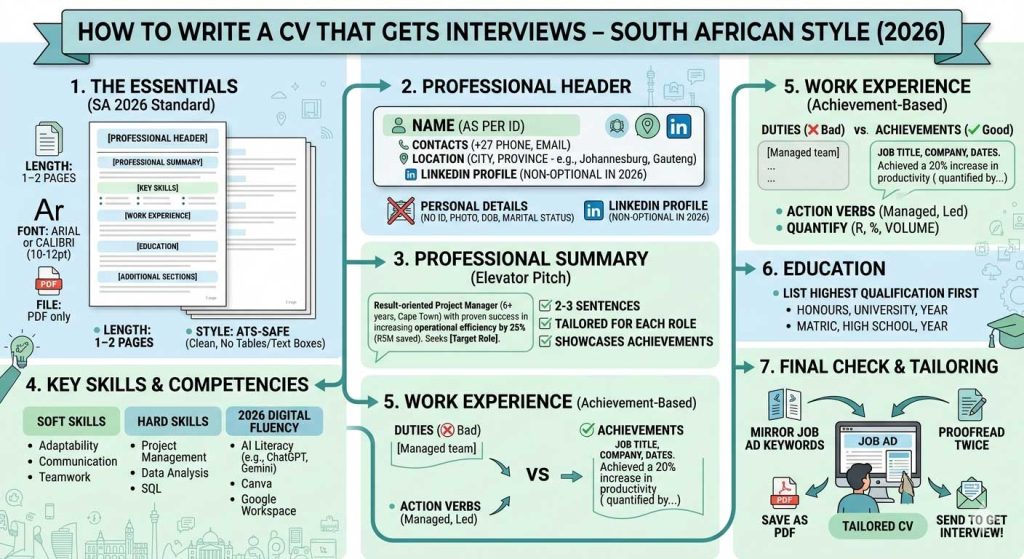
I have a friend who applied for twenty jobs with the same CV and got one interview. Then she changed her CV for each job – she read the job ad and used the same words in her CV. She got five interviews in two weeks. Try it.
In conclusion, a good CV is simple, honest, and easy to read. Do not try to be fancy. Do not lie. And always ask someone else to check your spelling. One typo can get your CV thrown away.