If you want to study further but your family does not have the money, a bursary can change your life. I have seen many students who think bursaries are only for people with 90% averages. That is not true. There are bursaries for people with 60% and even for people who are already working and want to study part time. In this post I will show you where to find bursaries in South Africa for 2026, and how to apply so you dont get rejected because of small mistakes.
First, let me explain the difference between a bursary and a student loan. A loan from a bank or from NSFAS (National Student Financial Aid Scheme) must be paid back. A bursary is free money – you do not pay it back. Some bursaries also give you a laptop, textbooks, and even a monthly living allowance. So always try for a bursary before you take a loan.
The biggest bursary provider in South Africa is NSFAS. But NSFAS is not a bursary – it is a loan that converts to a bursary if you pass your modules. Many students confuse this. For 2026, NSFAS is still funding students whose household income is below R350,000 per year. You apply online through myNSFAS. The application period is usually from September to January. Do not miss the deadline. I missed it once and had to wait a full year.
Now, what if you do not qualify for NSFAS? Or what if you need extra money for things NSFAS does not cover (like a laptop or transport)? Then you look for private bursaries and corporate bursaries.
Here is a list of big companies that give bursaries every year in South Africa: (Bursaries in South Africa)
- Mining companies: Anglo American, Sibanye-Stillwater, Impala Platinum. They want students in engineering, geology, metallurgy, and mining.
- Banks: Standard Bank, FNB, Absa, Nedbank. They fund commerce, accounting, economics, and IT.
- Retailers: Shoprite, Woolworths, Pick n Pay. They fund retail management, logistics, and supply chain.
- State owned companies: Eskom, Transnet, SABC, PRASA. They fund engineering, electrical, and media studies.
- Professional bodies: SAICA (for chartered accountants), SACNASP (for scientists), ECSA (for engineers).
How do you find these bursaries? Do not just Google “bursaries 2026” because you will get old information. Instead, go directly to the careers page of each company. Look for a tab that says “Bursaries” or “Study Support”. Also follow them on LinkedIn or Twitter because they announce bursary openings there.
Another good website to find Bursaries in South Africa is Careerwise (www.careerwise.co.za). They collect bursaries from many companies and sort them by field of study. I used Careerwise when I was applying for my degree and I found three bursaries I didn’t know about.
Now let me talk about the application process. You will usually need:
- Your latest academic results (grade 11 final and grade 12 if you have it)
- A letter of acceptance from a university or TVET college
- Your parents’ proof of income (pay slips or an affidavit)
- A motivational letter – this is very important
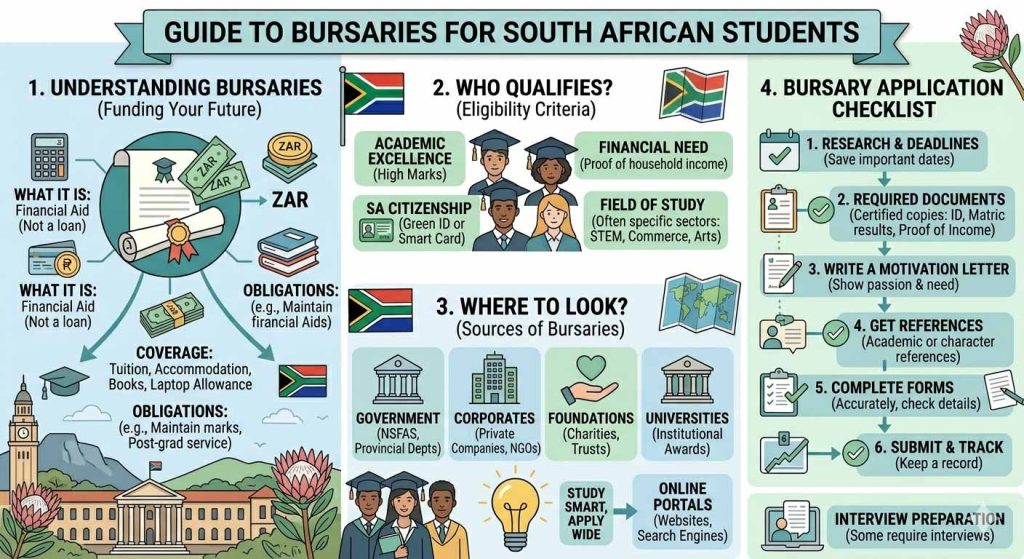
The motivational letter is where many students fail. They write “I want a bursary because I am poor”. That is not enough. You need to explain why you chose that field of study, what you want to do after you graduate, and how you will give back to the community. For example: “I want to study electrical engineering because there are no electricians in my village. After I graduate, I will come back and fix the transformers that break every week.” That kind of story works.
Also, check if the bursary requires you to work for the company after you finish. Some bursaries are called “service binding” – you must work for them for the same number of years they paid for your studies. That is fine, but you need to know before you sign.
One mistake I see often: students apply for a bursary but they do not read the minimum requirements. If the bursary needs 70% in maths and you have 55%, do not waste your time. Apply somewhere else. You can also look for bursaries that accept a lower pass – for example, some TVET college bursaries only need 50%.
In conclusion, bursaries in South Africa are available but you have to search properly and apply carefully. Start in August or September for 2027 applications. Use the company websites and Careerwise. Write a good motivational letter. And do not lie on your application – they check with your school. Good luck.